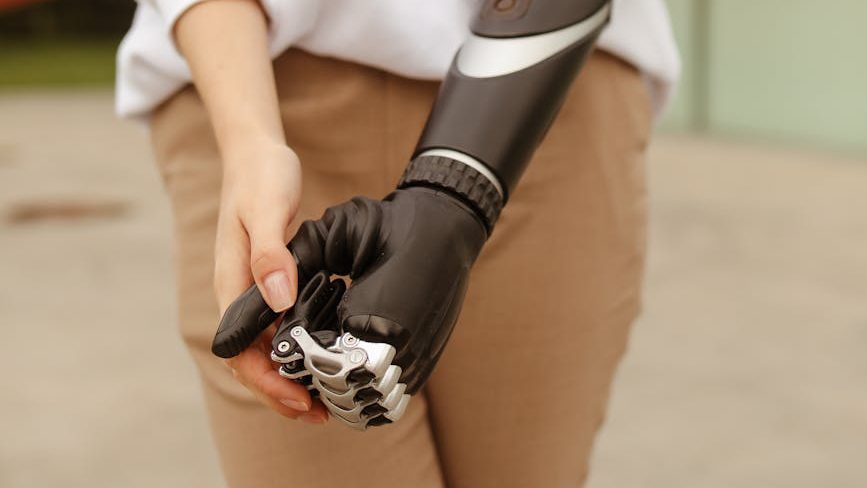
Organic Life vs Artificial Intelligence: 3 Reasons Biology Wins
The debate of organic life vs artificial intelligence is a common trope in Science Fiction. We often assume that AI and robotics represent the ultimate, natural trajectory for the progress of a civilization. We are told that flesh is weak and steel is eternal.
While this holds true to a point in my book, Whispers from the Machine, I wanted to explore an alternative. What if the advance to robotics is just a mid-step? In the battle of organic life vs artificial intelligence, what if organic life is actually the superior technology?
Here is why I believe biology, not machinery, might be the true “God-tier” tech.

1. Organic Life vs Artificial Intelligence: Complexity vs. Precision
This isn’t an entirely new concept. There are many great books and films that touch on bio-engineering as a core part of Human and Xeno advancements. Alien is an obvious example, but Dune, Shards of Earth, and The Expanse also explore the limits of biology.
I wanted to make this a subtle concept buried within the story of Whispers, serving as a core belief of a significant character.
When I was outlining the story (read my previous blog about my outlining process here), my early concepts focused heavily on the technological advancement of a lost civilization. However, the more I explored the concept of organic life vs artificial intelligence, the more I questioned the driving force behind their creation.
If an advanced civilization created a true AI and seeded it with the purpose of finding “perfection,” would it choose machines? Or would it decide to play God and perfect organic life?

2. Why Bio-Engineering is the Ultimate Evolution
Robotics has always seemed logical. It feels like you can create more complex, diverse, and resilient beings using metal and code. However, I think this view is flawed.
This might be my limited perspective of current robotics talking, but even our best machines are a shadow of what nature and evolution have created. Consider the tiny complexities of an ant colony, the giants of the ocean, or the long-lost dinosaurs.
The challenge is that organic life is usually based on the random, blind “progress” of evolution. It is not by design; it is the result of billions of failed attempts. That is why in the organic life vs artificial intelligence comparison, robots usually seem like the smarter choice—they are designed with purpose.
But here is the counter-argument: Any civilization advanced enough to achieve true General AI would surely have the ability to unlock bio-engineering at the highest level. If you can manipulate matter, why build a robot to mimic a hand when you can engineer a biological hand that heals itself, requires fuel that grows from the ground, and reproduces automatically?
In Whispers from the Machine, I explore the idea that an advanced intelligence might view organic life not as obsolete, but as a canvas waiting to be perfected.

3. The Dark Ethics of Perfection
This, of course, opens a massive can of worms regarding the ethics of bio-engineering. The risk it poses to non-engineered life is catastrophic.
We cannot discuss organic life vs artificial intelligence without acknowledging that the search for biological perfection is deeply rooted in the eugenics movements of the 20th century. This mindset set the scene for some of humanity’s worst atrocities. The most obvious example is the Nazi regime, but history also buries the fact that the British Empire and the United States had deep-rooted beliefs in eugenics.
World War II stalled that “progress,” and the world shifted away from it ethically. But as humanity moves into the stars, will these beliefs shift again?
Adrian Tchaikovsky deals with this brilliantly in Shards of Earth. If you want something more grounded in reality, Yuval Noah Harari explores this with great rigor in his excellent book, Homo Deus: A Brief History of Tomorrow.
I wanted to capture this tension in my latest book. Whispers from the Machine isn’t just about cool tech; it is about the challenge of searching for perfection and the destruction that search can inflict on a civilization.
Leave a Reply