When it comes to outlining a novel, finishing book three is officially done. Whoa there, in the last blog we were talking about book two! Yes, yes, I jumped ahead, but I have some downtime while book two is with the development editor. As the sage Brandon Sanderson explains, book production should not be linear; there should be multiple workstreams that cross over. So, I have taken that to heart as best I can. When I was finalising elements of book one, I was writing book two. Now, whilst book two sits with the editor, I took the time to work on book three.
So where are we at? Like the rest of the series, there was already a loose plan, but I’ve now taken that through the next stages of my workflow. I’ve talked about my personal evolution with outlining a novel before, and it has continued to adapt: from book one’s early stages where I mistakenly believed world-building equalled outlining, to the initial pure gardener approach, through to the more refined plot grids and chapter plans of book two.
Book three has taken that a little further, building on the lessons from book two. I want to point out that I am more than comfortable with the gardener approach. In fact, I would say letting the story grow organically as I write without a plan is my natural state. So although people have said I’m more of an architect in my writing, that is not my default. Even now, I feel I sit somewhere in the middle of the spectrum. However much I enjoy writing organically, I simply produce a better, more coherent, and flowing story when I plan. You can see it in book one (or at least I can), where structured planning took over my workflow compared to the earlier, more organic chapters. I’m not saying those early chapters are bad, but there was a lack of tightness and efficiency to them (which is not always a bad thing). The real comparison will be book two when it is finished, which has an all-round much more architectural approach.
So what is my approach now with book three? What has changed? It isn’t a huge overhaul, and some of it will sound familiar, but let me walk you through the four key steps I use when outlining a novel.
1. Narrative Spaghetti and Core Concepts

First, I start with a blank page and just throw ideas out: a narrative spaghetti of what I think I want the book to be. It’s an odd approach, for sure, but I find it helps immensely. It gets everything out of my head so I can start to understand what I will need to unpack and structure. This is also the step where I do broader research into themes, or elements that need to be more grounded in reality. I end up with a very messy document that is, to be fair, mostly useless to anyone but me. It is a strictly temporary foundation, but an essential first pass when outlining a novel.
2. The Master Plot Sheet
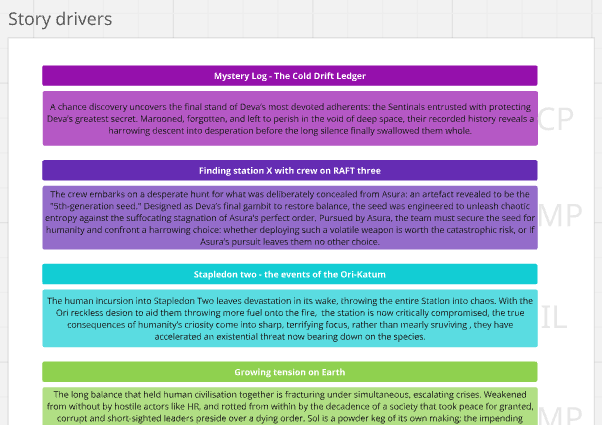
The next big, and I think most fun, step is what people would probably call a plot grid. I’m not sure it truly is one, though; it’s looser than that. I use it for storyboarding the plots I want to explore, taking the foundational concepts from step one and breaking them down into how do we get here, and through whose eyes? I start with each individual plot and unpack its elements: what are the major plot points that need to happen, and when? From there, I map all the plots together into a master plot sheet. To the best of my ability, I try to align this against a loose three-act structure, aiming for roughly 60 chapters. (Not that I’m locked into 60 chapters; it’s just a solid target length to aim for, at least for me and this story.)

3. Defining Plot Statements of Intent
A new step for book three was to define each of these plots in a more structured statement. This happens organically, just like the creation of the plot points, but I now create a clear statement of intent for each thread. This gives me a reliable reference point, so if I ever feel a little lost while outlining a novel, I can ensure the scenes still align with that core plot statement.

It is worth saying that, from experience, plots do shift. Elements are added or removed, or they are pushed into different acts and chapters. I keep that flexibility, but I try to discipline myself. Once you leave this bird’s-eye view and get down into the weeds of chapter-by-chapter writing, it is very easy to doubt the plan and want to change it. Sometimes that instinct is right, but I try to trust past Richard: the one who had the headspace to look at the big picture. We can always fix things after the development edit if we really have to.

4. The Detailed Chapter Plan
The final step, introduced in book two as an evolution of a book one process (where I used to start each chapter by jotting down quick notes from the plot matrix), is the detailed chapter plan. This document lists all the chapters I think I will need in order, along with who is in them and when they happen. Then, using the elements from the plot matrix, I expand each entry into a detailed scene breakdown.

This helps my process of outlining a novel for two main reasons:
- Bridging long gaps between writing sessions: Because I write part-time, production is relatively slow. The gap between planning and drafting, or even between one chapter and the next, can be wide; several months in many cases. That can make it hard to stay fully immersed in the flow and evolution of the story. Having this breakdown ensures I can simply pick up the next chapter, check the plan, and get straight into the writing, perhaps with just a quick glance back at the previous chapter. It limits my ability to make excuses, and stops the story drifting too far from its original vision.
- Spotting pacing issues early: The second reason, which I didn’t fully appreciate until I tried it, is that while the plot matrix is great, the chapter plan lets you feel out the flow of the story in true chronological order. Plot points that look sensible on a grid can suddenly feel off, premature, or delayed once you start working through the beats chapter by chapter. It really helps refine those plot threads into a cohesive, logical flow.
Anyway, this turned into a long blog on a topic I talk about often. Ultimately, outlining a novel has been my biggest learning curve in writing, and it has become my most valued step. Every time, I put more effort into the prep, because I know that when it comes to sitting down to draft, the time spent outlining a novel truly pays off.
Leave a Reply