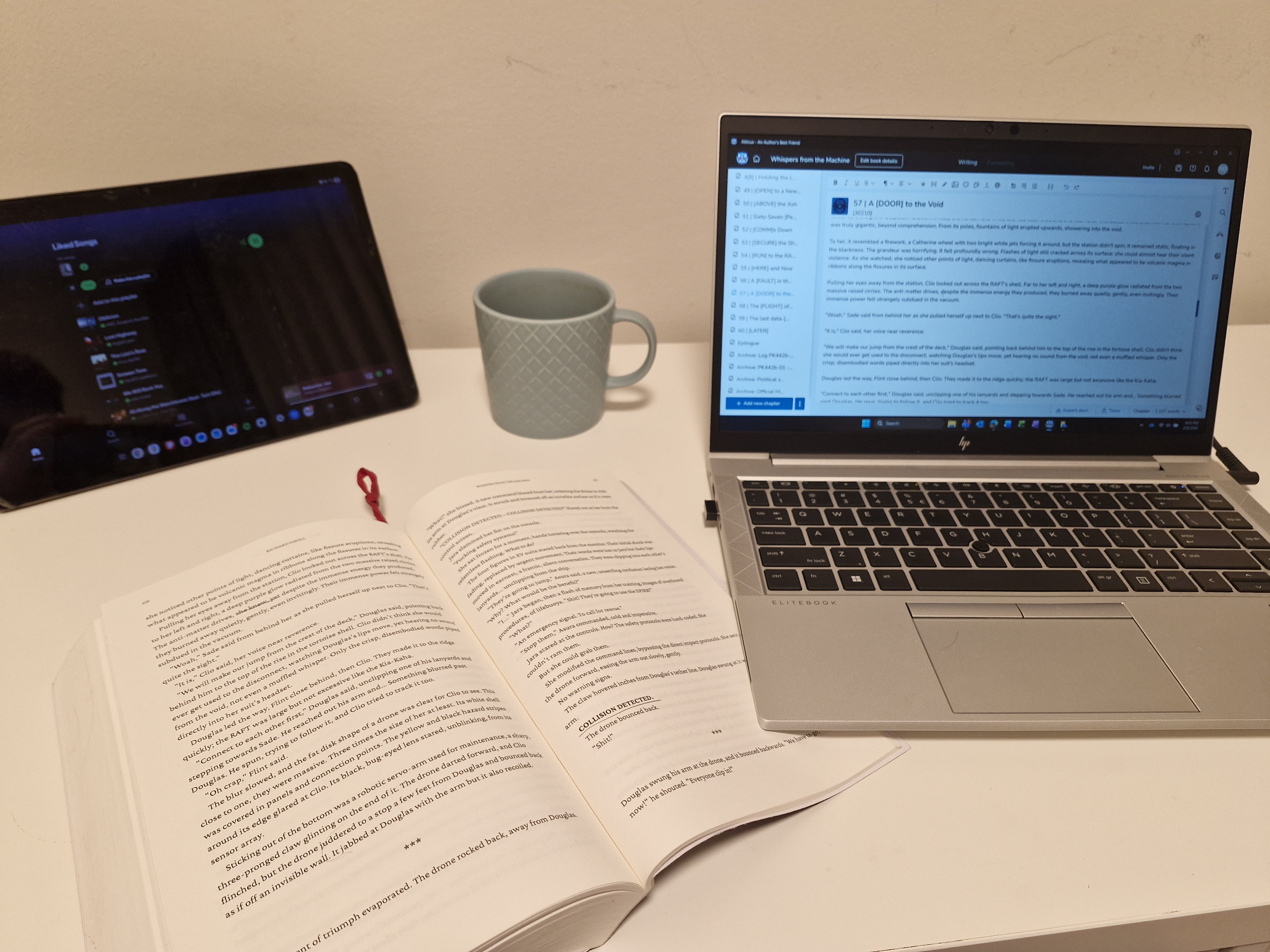
Book one hasn’t even left the shelves yet, and I want to talk about book two. Well, the truth is I really don’t. Not because I don’t like it; in fact, I think I love it more than book one. It is just a motivation issue. Any mention of writing book two reminds me of how far behind my arbitrarily set targets I am.
Whispers from the Machine was a passion project, as much a question of whether I could do it as anything else. Which I did. The actual writing of it largely stopped months ago, with the focus switching to marketing, production, and distribution. As I have mentioned in other blogs, I have been looking forward to getting back to the keyboard. At the same time, I am struggling to pick up the pen.
Can I even still write? Have I forgotten how? The longer I wait, the worse this feeling gets. I know it is irrational. I wrote the first book without knowing how to write, so even if I have somehow forgotten everything, I am starting in the same place. Well, not really. I am starting in a much better position, in fact.
Restarting the Process

I have the outline. I want to tweak it, naturally. I want to rework a plotline in Act two, refocusing it into a thread that will grow more naturally into book three. I also have all of Act one done. So, to say I need to start writing book two is a little bit of a lie. I need to restart it.
Maybe this is half the problem. I find it quite hard to pick up work I started before. I am great when I am in the zone and in the flow, but coming back to something is tricky. I found this even with Whispers from the Machine, which I largely wrote at a pace of a chapter a week. Even on my first revision, some of those chapters were six months old and felt distinctly alien to me.
Introducing Mutterings of the Deceased

The working title for the sequel is Mutterings of the Deceased. Yes, I know the title is the last thing you should come up with, but I like doing it early. For me, it helps frame the book and gives it a personality.
It is a direct continuation of book one, starting a few months after the closing events. The original concept was that it would be a standalone within the framework of a series: a new story with new characters, but connected to the wider Stapledon Series arc. I rolled this back quite early, well before I started writing book two. Keeping the threads built in book one, particularly the connections to Clio and Flint, was important, and so it was reworked to capture that.
Mutterings of the Deceased still explores the wider story arc as intended, introducing the sister ship the Fèndòu and the events at Stapledon Two. However, it also continues to follow the main cast from Whispers, weaving Clio and the gang into the interlinked story arc, ready for the events to connect and merge in books three and four.
Balancing Characters and Pace
Obviously, this creates a layer of complexity for me as the writer, but more so for the reader. The risk is having too many characters and too many plot threads. Balancing this while writing book two is my primary focus; the outline is the bedrock for achieving that balance. The other risk is pulling people away from what they liked in book one, dropping a whole new unfamiliar cast for them to grow to love. This can work, but it can also be very jarring for readers.
Personally, I love the new characters you follow in this sequel. Bringing Clio, Flint, and the rest back was a conscious decision because I did not want to abandon them. It is early days, but I am confident it works.
The story itself is a step change from book one. Where Whispers was a methodical build reflecting the logical progression of discovery in the vastness of space, book two is an explosion of chaos from Chapter one.
Finding the Flow Again

I love this shift. I think it makes Act one feel like Act three: punchy, fast-paced, and high stakes. The outline has the story mellow out in Act two, offering a moment to take a breath before you must dive back into the adventure. This pacing is very different from book one and carries the same risk. If people liked the slow, methodical exploration, the opening of book two could throw people off.
I am still excited for it. I am currently reading Act one of Mutterings of the Deceased to pull myself back into the story and into my writing flow. I am surprised at how impressed I am with the story. Usually, I am my own worst critic. It is not perfect (it is a draft zero), but the story beats are good, the characters are solid, and it reminds me there is something here worth pushing to finish.
So, let’s get back into it. Let’s put Whispers from the Machine behind me, pick up the pen, and dedicate myself to writing book two. Baby steps. I don’t need a draft next week, but by the end of the year? I can do that. It might mean reducing blog outputs and social media marketing to focus on this book. That’s why I started this: to write this story, so let’s do exactly that.
Leave a Reply