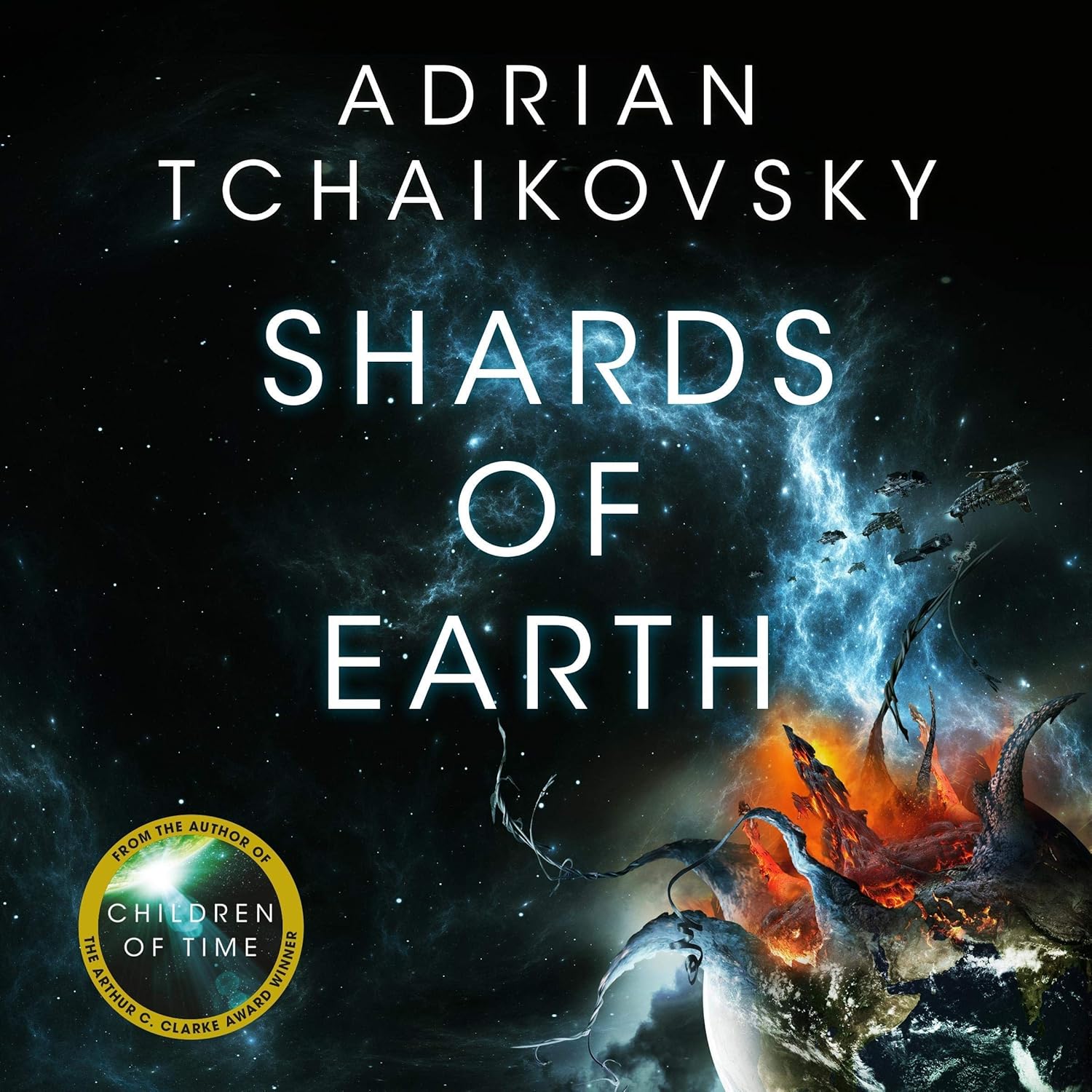
I’m reading an excellent book at the moment: Shards of Earth by Adrian Tchaikovsky. There are so many things I enjoy about it, but one in particular is the use of artificial gravity in sci-fi settings, not just for shipboard gravity, but for travel and as weapons.

I’ve pondered this myself. While writing my own first attempt at a novel, Whispers from the Machine, I had to decide whether or not to include artificial gravity. Eschewing it presents a number of challenges, especially for long-haul, multi-year travel.
Of course, there are alternatives to “space magic.” You can spin the ship (or at least part of it), or you can use magnetic boots. I even tried quite hard to rely on constant acceleration. In the end, however, I sided with the space magic, gifting future humans the ability to generate gravity fields through something called “gravity planting.”
Decision made. Done.
But being me (and I guess like many people, including Tchaikovsky), I had to ask: what are the implications of this crazy space magic? If you could control gravity to keep people on the floor of a ship, what else would humans do with it?
Weaponizing Artificial Gravity
Humans love weapons, so we would almost certainly weaponize gravity. Could you project a gravity field into an enemy spaceship, city, or planet, crushing it under sheer force?
If you could project a field, perhaps you could use it to create incredible acceleration for projectiles, like a rail cannon on steroids. Or you could simply lock people or objects in place, trapping them in a well they can’t escape.
Defense and Stealth
If we have weapons, we must have shields. A deflection field seems like the most obvious use, though “distortion” might be a better word. Or if you can project a gravity field, could you create a localized “bullet sponge” just to your left so nothing hits you?
Another thought I had—and I’m no scientist—but could you also use gravity distortion to bend light and, in turn, make yourself invisible? Stealth tech, anyone?
The Weird Possibilities of Gravity
Then you get into the truly fun and weird possibilities of artificial gravity in sci-fi. Like open-air space travel! Why build a pressure vessel at all when you could just take your atmosphere with you, held in place by a gravity field? You could go full Pirates of the Caribbean and sail around shooting gravity cannons at other open-air space pirates.
And what about time dilation? It could be the ultimate “skip to the future” button. Don’t want to see the in-laws this holiday season? Jump in your gravity time-compression pod for five minutes and wake up next year. Oh damn… it’s holiday season again. Oops.
Setting Limits in My Own Writing
Ultimately, it was fun exploring the ramifications of such amazing space magic. The concept of artificial gravity in sci-fi is often overlooked or taken for granted.
In my own writing, I tried to limit the “magic” by tying it to energy consumption; it requires a massive amount of power, a whole reactor’s worth, just to generate a stable 1G field. Furthermore, I made it exponentially harder to generate a field beyond 1G; the power requirements increase by thousands for every small increment, making it largely unscalable.
I also decided that it couldn’t be projected; it is created strictly around the “gravity planting” tech itself. To avoid pesky singularities, the machine would be crushed under its own field long before it created anything truly world-ending.
Final Thoughts on Artificial Gravity in Sci-Fi
Whether it is used for weapons, shields, or just keeping tea in a cup, artificial gravity in sci-fi offers endless possibilities for worldbuilding beyond simple space magic.
Do read Shards of Earth, though. It really is an excellent read.
Leave a Reply